

Analysis III (Masstheorie), D-MATH
Fall Semester 2026
Lecturer: Prof. Francesca Da Lio
Exercise hours coordinator: Antonio Marini
- Lecture Notes (These notes will be continuously upadated during the course)
- Class Notes
- Course Webpage
Course Description
This course introduces the modern theory of measure and integration, with particular emphasis on Lebesgue measure and the Lebesgue integral on R^n . Students learn how Lebesgue integration extends the Riemann integral, study its fundamental convergence theorems, and develop the measure-theoretic foundations needed for further study in analysis, probability theory, and functional analysis.
Learning Objectives
By the end of the course, students should be able to:
-
Understand the basic structures of measure theory
Define and work with rings, algebras, (\sigma)-algebras, measurable spaces, measures, and measure spaces, and verify their fundamental properties.
-
Construct measures from elementary set functions
Understand the construction of measures and apply the Carathéodory criterion and the Carathéodory–Hahn extension theorem to obtain measures.
-
Work confidently with Lebesgue measure
Understand the construction and principal properties of Lebesgue measure on R^n, and explain how it extends the classical notions of length, area, and volume.
-
Understand measurable functions
Recognize and construct measurable functions, and establish measurability under algebraic operations, limits, suprema, and infima.
-
Distinguish the principal notions of convergence
Understand the differences and relations between pointwise convergence, almost-everywhere convergence, uniform convergence, convergence in measure, and L^p-convergence.
-
Define and compute the Lebesgue integral
Construct the Lebesgue integral starting from simple functions and extend it to non-negative measurable and integrable functions.
-
Apply the main convergence theorems
Recognize when and how to use Fatou’s lemma, the Monotone Convergence Theorem, the Dominated Convergence Theorem, and Vitali’s convergence theorem.
-
Compare Lebesgue and Riemann integration
Explain the relationship between the two theories and identify situations in which Lebesgue integration provides a more flexible framework.
-
Work with L^p-spaces
Define the spaces L^p(\Omega,\mu), use Hölder’s and Minkowski’s inequalities, and understand the completeness of L^p-spaces.
-
Work with product measures and iterated integrals
Construct product measures and apply the Tonelli and Fubini theorems to justify the interchange of integrals and compute multiple integrals.
-
Apply the change-of-variables formula
Use the transformation formula for Lebesgue integrals and apply it in concrete calculations in R^n.
-
Understand basic properties of convolution
Define convolution, establish its integrability and regularity properties, and recognize its role in approximation and in the study of partial differential equations.
-
Become familiar with selected advanced applications
Understand the basic ideas behind Hausdorff measure and dimension, Radon measures, the Lebesgue Differentiation Theorem.
-
Develop rigorous proof and problem-solving skills
Formulate precise mathematical arguments, verify the hypotheses of abstract theorems, construct examples and counterexamples, and apply measure-theoretic tools to problems.
Diary of the lectures
| #Week | Date | Content | Reference |
|---|---|---|---|
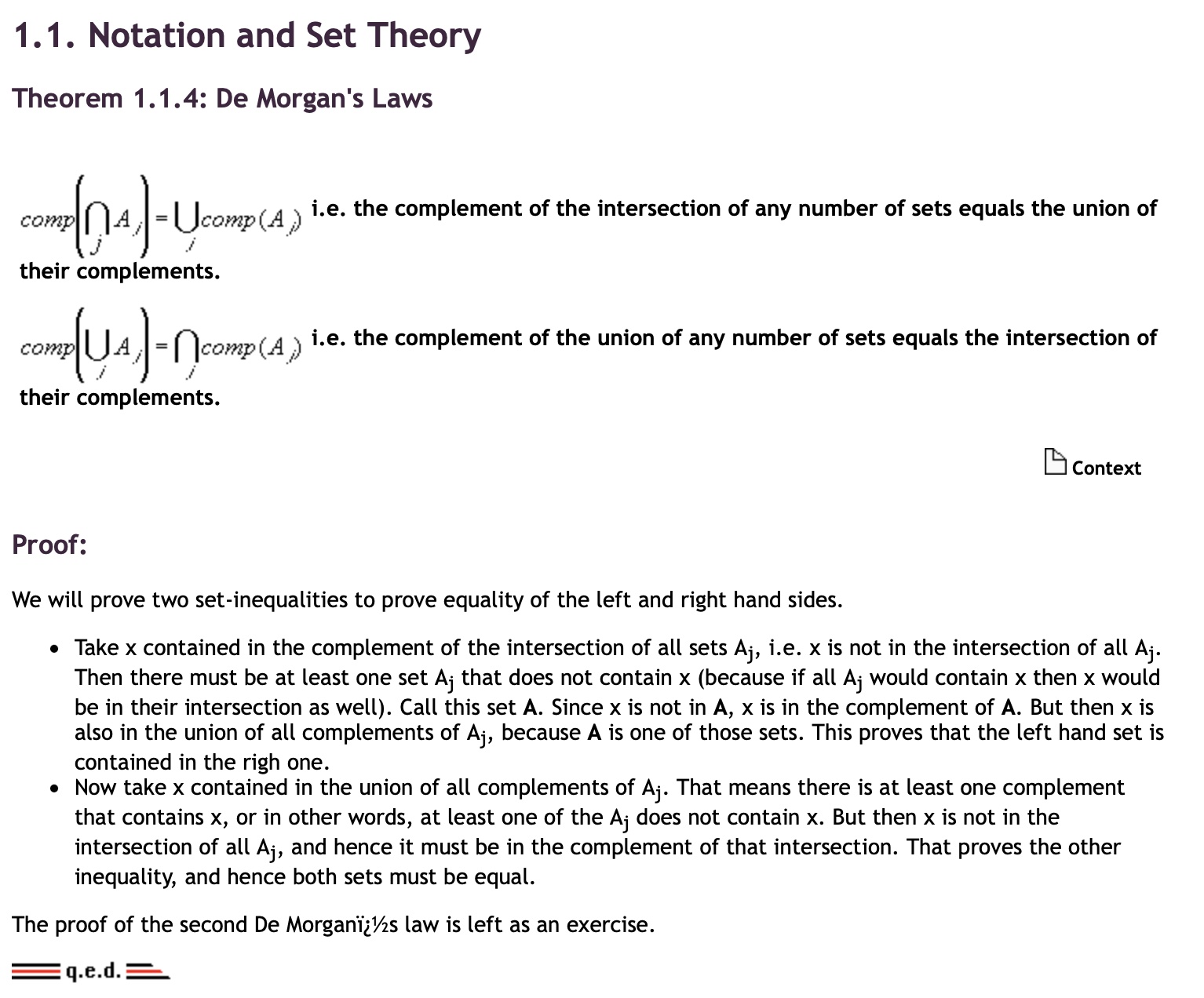
| 1 | 16-18.09.2026 | Slides of presentation of the course. Preliminary notations and definitions, limsup, liminf of sequences of sets, limit of monotone sequences of sets, rings, algebras, sigma-algebras, examples. Sigma-algebra of Borel sets, examples, definition of additive and sigma-additive functions | Sections 1.1 and 1.2 and 1.3 (until Definition 1.3.1 included) in the Lecture Notes. For curiosity:1) A proof of De Morgan Identities; 2)A Non-Borel set; 3) The Axiom of Choice and its implications in mathematics |
| 2 | 25.09.2025 | Proof of Propositions 1.32, 1.3.3, 1.3.4(proof of the fact that an additive function is sigma-additive iff it is subadditive). Example 1.3.6, 1.3.7. Definition of a measure and of measurable sets. Proof of Theorem 1.4.7 (the set of measurable sets is a sigma algebra), definition of a measure Space, Exercise 1.4.9, proof of Theorem 1.4.10 (continuity properties of a measure). Definition of a covering. Proof of Theorem 1.4.14. (construction of a measure). | Section 1.3 & 1.4.1 until page 15 in the Lecture Notes |
| 3 | 30.09-2.10.2026 | Definition of a covering. Proof of Theorem 1.4.14 (construction of a measure). Definition of a pre-measure. Examples. Proof of Theorem 1.4.16 (Carathéodory-Hahn extension). Statement of Theorem 1.4.17 (Uniqueness Carathéodory-Hahn extension). Rematk 1.4.18. Example 1.4.19. Definition of a multi-interval, volume of a multi-interval. Sigma-subadditivity of the volume. Definition of Lebesqgue measure. Dydadic Decomposition of R^n. Proof of Lemma 1.5.4. The Lebesgue measure is a Borel measure. Regularity properties of Lebesgue measure. Proof of Theorem 1.5.7. a | Section 1.4 and 1.5. in the Lecture Notes. |
| 4 | 7-9.10.2026 | Proof of Theorem 1.5.8 (characterisation of Lebesgue measurable sets). Comparison between Lebesgue and Jordan measures.Proof of Theorem 1.6.1. Examples of non measurable Jordan sets. Statement of Theorem 1.6.2. Proof of Corollary 1.6.4 (the Lebesgue measure is Borel regular). Construction of Vitali set and proof of the fact it is not Lebesgue measurable. Interactive exercises. | Section 1.6 and 1.7 in the Lecture Notes. For curiosity: 1) An Overview of Jordan Measure (Bachelor Thesis). 2) An example of Lebesgue measurable set in R which is not Borel,3) Banach-Tarski theorem,4) Some pathological sets in the standard theory of Lebesgue measure (Bachelor thesis). Some references on the axiom of the choice: 5) A look at the world without the axiom of the choice, 6) A Model of Set-Theory in Which Every Set of Reals is Lebesgue Measurable,7) The Axiom of Choice and its implications in mathematics |
| 5 | 15-17.10.2026 | Description of the Cantor triadic set : example of an uncountable with zero Lebesgue measure. Its representation in base b=3. Lebesgue-Stieltjes measures. Definition of metric measures in $R^n$. Proof of Theorem 1.9.4 and Theorem 1.9.5. Interactive exercises. | Sections 1.8, 1.9 in the Lecture Notes |
| 6 | 21-23.10.2024 | Introduction of Hausdorff measure. Proof of the fact that the zero dimensional Hausdorff measure is the counting measure. Definition of metric measure. Proof of Theorem 1.10.3 (the s-dimensional Hausdorff measure is a Borel regular measure). Proof of Remark 1.10.5. Proof of Lemma 1.10.5, Example 1.10.6. Definition of the Hausdorff dimension of a set of $R^n$. Some remarks about the Hausdorff dimension of subsets of $R^n$. Examples of fractals. | Sections 1.10 in the Lecture Notes. Just for curiosity: 1) Fractals and 2) Prof. R. Mingione's talk about fractals (in italian) and 3) The unlimited s- Hausdorff measure is not in general a Borel measure |
Recommended bibliography (Undergraduate-Master level):
- Lawrence Evans and Ronald Gariepy, Measure Theory and Fine Properties of Functions, Textbooks in Mathematics, CRC Press, 2015.
- Gerald B. Folland, Real Analysis: Modern Techniques and Their Applications
- Michael Struwe, Analysis III: Mass und Integral, Lecture Notes, ETH Zürich, 2013.
- Piermarco Cannarsa and Teresa D'Aprile, Lecture Notes on Measure Theory and Functional Analysis, Lecture Notes, University of Rome, 2006.
- Terence Tao, An Introduction to Measure Theory, American Mathematical Society, 2011.
- Herbert Amann and Joachim Escher, Analysis III, 2009 Birkhäuser Verlag AG.
-
Recap of basic topology notions: Chapter 4 in the lecture notes Analysis I and II Michael Struwe
Further reading:
- W.F. Eberlein, Notes on Integration I: The Underlying Convergence Theorem, Comm. Pure Appl. Math. 10 (1957), 357–360.
- Ask yourself dumb questions – and answer them! (by Terence Tao);
- Why mathematician Terence Tao thinks AI must spark a rapid revolution, Interview to Terence Tao in [NewScientist] (https://www.newscientist.com/article/2583307-why-mathematician-terence-tao-thinks-ai-must-spark-a-rapid-revolution/)
- How to write Mathematics (by Paul R. Halmos)